

Claude code 重试策略修改
donnad
2026-06-24 23:21
1
Claude code api失败重试策略为exponential backoff,并且v2.1.186开始重试次数上限为15次,见 Environment variables - Claude Code Docs。
有些公益站使用不稳定,Claude code现在的策略导致等待时间久,并且长任务会中断,所以用ai修改下Claude code二进制文件,实现为1s间隔重试,重试次数最大99次。
效果
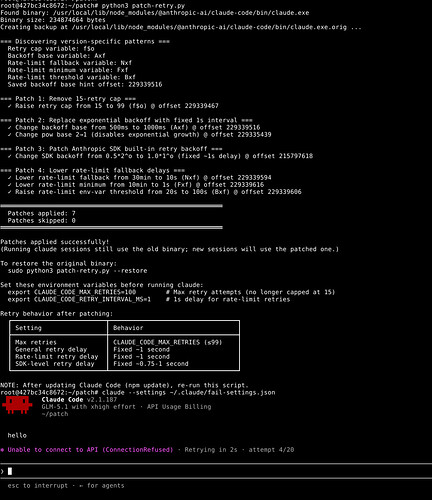
执行patch(仅在linux环境验证过v2.1.186,v2.1.187)
python3 patch-retry.py
脚本
#!/usr/bin/env python3

"""

patch-retry.py — Patch Claude Code binary to:

  1. Remove the 15-retry cap on CLAUDE_CODE_MAX_RETRIES

  2. Replace exponential backoff with fixed 1s interval

  3. Patch the Anthropic SDK's built-in retry backoff

  4. Lower rate-limit fallback delays


Usage:

  sudo python3 patch-retry.py [--dry-run] [--restore]


Options:

  --dry-run   Show what would be changed without modifying the binary

  --restore   Restore the original binary from backup


Environment variables (after patching):

  CLAUDE_CODE_MAX_RETRIES=100       — Max retry attempts (no longer capped at 15)

  CLAUDE_CODE_RETRY_INTERVAL_MS=1   — Fixed 1s delay for rate-limit retries


Version-agnostic: This script dynamically discovers minified variable names

by searching for code structure patterns (e.g. "clamped to ${VAR}" near

"CLAUDE_CODE_MAX_RETRIES") rather than hardcoding variable names. This

allows it to work across versions where minification produces different names.

"""


import argparse

import os

import re

import shutil

import subprocess

import sys


def find_binary() -> str:

    """Find the Claude Code binary path."""

    # Try `which claude` first

    try:

        result = subprocess.run(

            ["which", "claude"], capture_output=True, text=True, timeout=5

        )

        if result.returncode == 0:

            path = os.path.realpath(result.stdout.strip())

            if os.path.isfile(path):

                return path

    except Exception:

        pass


    # Fallback: look in npm global packages

    try:

        result = subprocess.run(

            ["npm", "root", "-g"], capture_output=True, text=True, timeout=5

        )

        if result.returncode == 0:

            npm_root = result.stdout.strip()

            candidates = [

                os.path.join(npm_root, "@anthropic-ai/claude-code/bin/claude.exe"),

                os.path.join(npm_root, "@anthropic-ai/claude-code-linux-x64/claude"),

                os.path.join(npm_root, "@anthropic-ai/claude-code-linux-arm64/claude"),

                os.path.join(npm_root, "@anthropic-ai/claude-code-darwin-arm64/claude"),

                os.path.join(npm_root, "@anthropic-ai/claude-code-darwin-x64/claude"),

            ]

            for c in candidates:

                if os.path.isfile(c):

                    return os.path.realpath(c)

    except Exception:

        pass


    print("ERROR: Could not find Claude Code binary. Is it installed?", file=sys.stderr)

    print("Try: npm install -g @anthropic-ai/claude-code", file=sys.stderr)

    sys.exit(1)


def find_all(data: bytes, pattern: bytes) -> list[int]:

    """Find all offsets of a byte pattern in data."""

    offsets = []

    start = 0

    while True:

        idx = data.find(pattern, start)

        if idx == -1:

            break

        offsets.append(idx)

        start = idx + 1

    return offsets


def find_nearest(data: bytes, pattern: bytes, ref_offset: int, max_dist: int) -> int | None:

    """Find the offset of pattern closest to ref_offset, within max_dist."""

    offsets = find_all(data, pattern)

    best = None

    best_dist = max_dist

    for off in offsets:

        dist = abs(off - ref_offset)

        if dist < best_dist:

            best_dist = dist

            best = off

    return best


def apply_byte_patch(data: bytearray, desc: str, search: bytes, replace: bytes,

                     stats: dict, hint_offset: int | None = None,

                     max_dist: int = 0) -> bytearray:

    """Apply a single search→replace byte patch. Returns modified data.


    If hint_offset is provided, finds the search pattern nearest to that offset

    within max_dist. Otherwise, uses the first occurrence.

    """

    if len(search) != len(replace):

        print(f"  SKIP: {desc} — byte length mismatch ({len(search)} vs {len(replace)})", file=sys.stderr)

        stats["failed"] += 1

        return data


    if hint_offset is not None:

        offset = find_nearest(data, search, hint_offset, max_dist)

        if offset is None:

            print(f"  WARN: Could not find pattern near hint for: {desc}", file=sys.stderr)

            stats["failed"] += 1

            return data

    else:

        offsets = find_all(data, search)

        if not offsets:

            print(f"  WARN: Could not find pattern for: {desc}", file=sys.stderr)

            stats["failed"] += 1

            return data

        offset = offsets[0]


    # Verify the bytes at the offset match

    actual = data[offset:offset + len(search)]

    if actual != search:

        print(f"  SKIP: {desc} — byte mismatch at offset {offset}", file=sys.stderr)

        print(f"    Expected: {search.hex()}", file=sys.stderr)

        print(f"    Actual:   {actual.hex()}", file=sys.stderr)

        stats["failed"] += 1

        return data


    print(f"  ✓ {desc} @ offset {offset}")

    data[offset:offset + len(replace)] = replace

    stats["applied"] += 1

    return data


# ─── Dynamic pattern discovery ────────────────────────────────────────────────

# These functions discover minified variable names by searching for code

# structure patterns that are stable across versions (the logic stays the

# same even as minifier output changes variable names).


def discover_retry_cap_var(data: bytes) -> bytes | None:

    """Discover the retry cap variable name from the 'clamped to' message.


    The code always contains:

        `CLAUDE_CODE_MAX_RETRIES=${e} clamped to ${VARNAME}`

    where VARNAME=15 is the cap we want to raise.

    """

    for m in re.finditer(rb'CLAUDE_CODE_MAX_RETRIES=\$\{', data):

        ctx = data[m.start():m.start() + 200]

        clamped = re.search(rb'clamped to \$\{([a-zA-Z_$][a-zA-Z0-9_$]*)\}', ctx)

        if clamped:

            return clamped.group(1)

    return None


def discover_backoff_base_var(data: bytes) -> bytes | None:

    """Discover the backoff base variable name from the retry delay formula.


    The code always contains:

        Math.min(VARNAME*Math.pow(2,e-1),n)

    where VARNAME=500 is the base delay in ms.

    """

    for m in re.finditer(rb'Math\.min\(([a-zA-Z_$][a-zA-Z0-9_$]*)\*Math\.pow\(2,e-1\)', data):

        return m.group(1)

    return None


def discover_rate_limit_vars(data: bytes) -> tuple[bytes | None, bytes | None, bytes | None]:

    """Discover rate-limit variable names from the rate-limit handling code.


    The code always contains:

        R!==null&&R<THRESHOLD_VAR   — if retry interval < threshold, use it

        Math.max(R??FALLBACK_VAR,MIN_VAR)  — fallback and minimum delays

    near the string "rate_limit".


    Returns (fallback_var, min_var, threshold_var) or Nones.

    """

    fallback_var = None

    min_var = None

    threshold_var = None


    idx = data.find(b'rate_limit')

    while idx != -1:

        before = data[max(0, idx - 500):idx]

        if b'Math.max' in before:

            # Extract Math.max(R??VAR1,VAR2)

            pos = before.rfind(b'Math.max(R??')

            if pos >= 0:

                rest = before[pos + len(b'Math.max(R??'):]

                m = re.match(rb'([a-zA-Z_$][a-zA-Z0-9_$]*),([a-zA-Z_$][a-zA-Z0-9_$]*)\)', rest)

                if m:

                    fallback_var = m.group(1)

                    min_var = m.group(2)


            # Extract R!==null&&R<THRESHOLD

            m2 = re.search(rb'R!==null&&R<([a-zA-Z_$][a-zA-Z0-9_$]*)', before)

            if m2:

                threshold_var = m2.group(1)


            if fallback_var and min_var and threshold_var:

                return fallback_var, min_var, threshold_var


        idx = data.find(b'rate_limit', idx + 1)


    return fallback_var, min_var, threshold_var


def main():

    parser = argparse.ArgumentParser(

        description="Patch Claude Code binary: remove retry cap, fix backoff to 1s interval"

    )

    parser.add_argument("--dry-run", action="store_true", help="Show changes without modifying the binary")

    parser.add_argument("--restore", action="store_true", help="Restore the original binary from backup")

    args = parser.parse_args()


    binary_path = find_binary()

    print(f"Found binary: {binary_path}")

    print(f"Binary size: {os.path.getsize(binary_path)} bytes")


    backup_path = binary_path + ".orig"


    # ── Restore mode ──────────────────────────────────────────────────────────

    if args.restore:

        if not os.path.isfile(backup_path):

            print(f"ERROR: No backup found at {backup_path}", file=sys.stderr)

            sys.exit(1)

        print(f"Restoring original binary from {backup_path} ...")

        try:

            shutil.copy2(backup_path, binary_path)

            os.chmod(binary_path, 0o755)

            print("Restored successfully.")

        except OSError as e:

            print(f"ERROR: Failed to restore: {e}", file=sys.stderr)

            print("Is claude running? Stop it first.", file=sys.stderr)

            sys.exit(1)

        return


    # ── Create backup ─────────────────────────────────────────────────────────

    if not os.path.isfile(backup_path):

        print(f"Creating backup at {backup_path} ...")

        try:

            shutil.copy2(binary_path, backup_path)

        except OSError as e:

            print(f"ERROR: Failed to create backup: {e}", file=sys.stderr)

            print("Is claude running? Stop it first.", file=sys.stderr)

            sys.exit(1)


    # ── Read binary ───────────────────────────────────────────────────────────

    with open(binary_path, "rb") as f:

        data = bytearray(f.read())


    # ── Discover minified variable names dynamically ──────────────────────────

    print()

    print("=== Discovering version-specific patterns ===")


    retry_cap_var = discover_retry_cap_var(data)

    if retry_cap_var:

        print(f"  Retry cap variable: {retry_cap_var.decode()}")

    else:

        print("  WARN: Could not discover retry cap variable", file=sys.stderr)


    backoff_base_var = discover_backoff_base_var(data)

    if backoff_base_var:

        print(f"  Backoff base variable: {backoff_base_var.decode()}")

    else:

        print("  WARN: Could not discover backoff base variable", file=sys.stderr)


    rl_fallback_var, rl_min_var, rl_threshold_var = discover_rate_limit_vars(data)

    if rl_fallback_var:

        print(f"  Rate-limit fallback variable: {rl_fallback_var.decode()}")

    if rl_min_var:

        print(f"  Rate-limit minimum variable: {rl_min_var.decode()}")

    if rl_threshold_var:

        print(f"  Rate-limit threshold variable: {rl_threshold_var.decode()}")

    if not rl_fallback_var or not rl_min_var or not rl_threshold_var:

        print("  WARN: Could not discover all rate-limit variables", file=sys.stderr)


    # ── Save hint offset for Math.pow patch before backoff base is overwritten ──

    backoff_base_hint_offset = None

    if backoff_base_var:

        search = backoff_base_var + b"=500"

        hits = find_all(data, search)

        if hits:

            backoff_base_hint_offset = hits[0]

            print(f"  Saved backoff base hint offset: {backoff_base_hint_offset}")


    # ── Apply patches ─────────────────────────────────────────────────────────

    stats = {"applied": 0, "failed": 0}


    # ── Patch 1: Remove 15-retry cap ──────────────────────────────────────────

    print()

    print("=== Patch 1: Remove 15-retry cap ===")

    if retry_cap_var:

        search = retry_cap_var + b"=15"

        replace = retry_cap_var + b"=99"

        data = apply_byte_patch(data, f"Raise retry cap from 15 to 99 ({retry_cap_var.decode()})", search, replace, stats)

    else:

        print("  SKIP: Retry cap variable not discovered", file=sys.stderr)

        stats["failed"] += 1


    # ── Patch 2a: Change backoff base from 500ms to 1000ms ────────────────────

    print()

    print("=== Patch 2: Replace exponential backoff with fixed 1s interval ===")

    if backoff_base_var:

        search = backoff_base_var + b"=500"

        replace = backoff_base_var + b"=1e3"

        data = apply_byte_patch(data, f"Change backoff base from 500ms to 1000ms ({backoff_base_var.decode()})", search, replace, stats)

    else:

        print("  SKIP: Backoff base variable not discovered", file=sys.stderr)

        stats["failed"] += 1


    # ── Patch 2b: Disable exponential growth ──────────────────────────────────

    # Math.pow(2,e-1) → Math.pow(1,e-1)  (pow(1,n) always = 1)

    # Use the saved hint offset from the backoff base variable to find the

    # correct occurrence (there may be multiple Math.pow(2,e-1) in the binary)

    data = apply_byte_patch(

        data,

        "Change pow base 2→1 (disables exponential growth)",

        b"Math.pow(2,e-1)",

        b"Math.pow(1,e-1)",

        stats,

        hint_offset=backoff_base_hint_offset,

        max_dist=100000,

    )


    # ── Patch 3: Patch Anthropic SDK built-in retry backoff ───────────────────

    # 0.5*Math.pow(2,o) → 1.0*Math.pow(1,o)

    # This is in the SDK code, not minified app code, so the pattern is stable

    print()

    print("=== Patch 3: Patch Anthropic SDK built-in retry backoff ===")

    data = apply_byte_patch(

        data,

        "Change SDK backoff from 0.5*2^o to 1.0*1^o (fixed ~1s delay)",

        b"0.5*Math.pow(2,o)",

        b"1.0*Math.pow(1,o)",

        stats,

    )


    # ── Patch 4: Lower rate-limit fallback delays ─────────────────────────────

    print()

    print("=== Patch 4: Lower rate-limit fallback delays ===")

    if rl_fallback_var:

        # Fallback: 1800000ms (30min) → 0010000ms (10s)

        search = rl_fallback_var + b"=1800000"

        replace = rl_fallback_var + b"=0010000"

        data = apply_byte_patch(data, f"Lower rate-limit fallback from 30min to 10s ({rl_fallback_var.decode()})", search, replace, stats)

    else:

        print("  SKIP: Rate-limit fallback variable not discovered", file=sys.stderr)

        stats["failed"] += 1


    if rl_min_var:

        # Minimum: 600000ms (10min) → 001000ms (1s)

        search = rl_min_var + b"=600000"

        replace = rl_min_var + b"=001000"

        data = apply_byte_patch(data, f"Lower rate-limit minimum from 10min to 1s ({rl_min_var.decode()})", search, replace, stats)

    else:

        print("  SKIP: Rate-limit minimum variable not discovered", file=sys.stderr)

        stats["failed"] += 1


    if rl_threshold_var:

        # Threshold: 20000ms (20s) → 99999ms (100s)

        search = rl_threshold_var + b"=20000"

        replace = rl_threshold_var + b"=99999"

        data = apply_byte_patch(data, f"Raise rate-limit env-var threshold from 20s to 100s ({rl_threshold_var.decode()})", search, replace, stats)

    else:

        print("  SKIP: Rate-limit threshold variable not discovered", file=sys.stderr)

        stats["failed"] += 1


    # ── Summary ───────────────────────────────────────────────────────────────

    print()

    print("═══════════════════════════════════════════════════════════")

    print(f"  Patches applied: {stats['applied']}")

    print(f"  Patches skipped: {stats['failed']}")

    print("═══════════════════════════════════════════════════════════")


    if args.dry_run:

        print()

        print("DRY RUN — no changes were made.")

        print("Run without --dry-run to apply patches.")

        return


    # ── Write patched binary ──────────────────────────────────────────────────

    # Use a temp file + os.rename() to avoid "Text file busy" (ETXTBSY) when

    # the binary is currently running. On Linux, rename() is atomic and

    # replaces the inode — the running process keeps its old mapping, while

    # new invocations use the patched binary.

    if stats["applied"] > 0:

        import tempfile

        binary_dir = os.path.dirname(binary_path)

        try:

            fd, tmp_path = tempfile.mkstemp(dir=binary_dir, suffix=".tmp")

            try:

                os.write(fd, data)

                os.close(fd)

                os.chmod(tmp_path, 0o755)

                os.rename(tmp_path, binary_path)

            except Exception:

                os.close(fd) if not getattr(fd, 'closed', True) else None

                try:

                    os.unlink(tmp_path)

                except OSError:

                    pass

                raise

            print()

            print("Patches applied successfully!")

            print("(Running claude sessions still use the old binary; new sessions will use the patched one.)")

        except OSError as e:

            print(f"\nERROR: Failed to write patched binary: {e}", file=sys.stderr)

            print("Is claude running? Stop it first, then re-run this script.", file=sys.stderr)

            sys.exit(1)


    print()

    print("To restore the original binary:")

    print(f"  sudo python3 {sys.argv[0]} --restore")

    print()

    print("Set these environment variables before running claude:")

    print("  export CLAUDE_CODE_MAX_RETRIES=100        # Max retry attempts (no longer capped at 15)")

    print("  export CLAUDE_CODE_RETRY_INTERVAL_MS=1    # 1s delay for rate-limit retries")

    print()

    print("Retry behavior after patching:")

    print("  ┌─────────────────────────┬──────────────────────────────────┐")

    print("  │ Setting                 │ Behavior                         │")

    print("  ├─────────────────────────┼──────────────────────────────────┤")

    print("  │ Max retries             │ CLAUDE_CODE_MAX_RETRIES (≤99)    │")

    print("  │ General retry delay     │ Fixed ~1 second                  │")

    print("  │ Rate-limit retry delay  │ Fixed ~1 second                  │")

    print("  │ SDK-level retry delay   │ Fixed ~0.75-1 second             │")

    print("  └─────────────────────────┴──────────────────────────────────┘")

    print()

    print("NOTE: After updating Claude Code (npm update), re-run this script.")


if __name__ == "__main__":

    main()
最新回复 (5)
-
 Zeus Jie 06-24 23:221楼
强上 any 是吧 有点心动了 想试试
-
 双色辉光 06-24 23:322楼
谢谢佬的分享,看起来很不错诶。
但是不知道一直重试会不会对公益站造成困扰,导致封号,有点担心啊。 -
 Thanatos 06-24 23:363楼
不排除这个可能性,所以风险自负了
-
 DaChui 06-25 15:354楼
让MIMO改了下:
我的是V2.1.191,windows系统
可以先自己用–dry-run测试好再跑
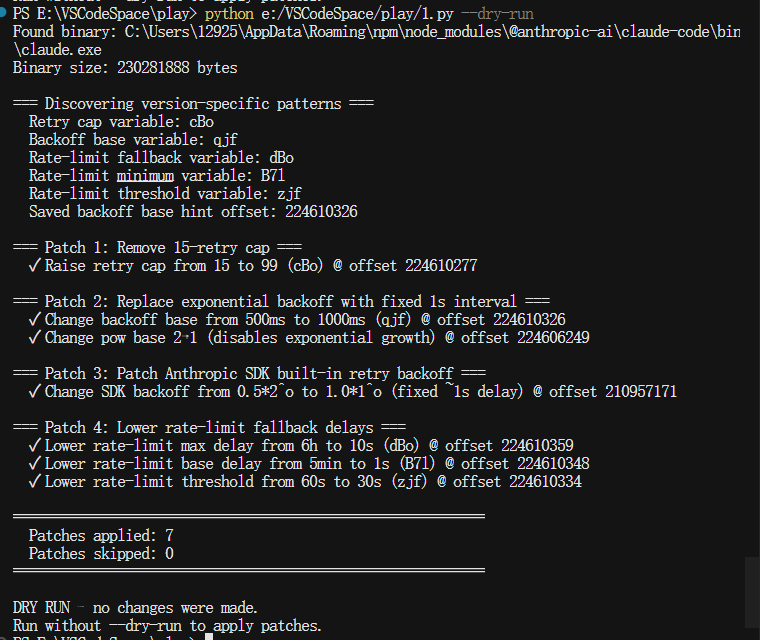
修改后的代码
#!/usr/bin/env python3

"""

patch-retry.py — Patch Claude Code binary to:

  1. Remove the 15-retry cap on CLAUDE_CODE_MAX_RETRIES

  2. Replace exponential backoff with fixed 1s interval

  3. Patch the Anthropic SDK's built-in retry backoff

  4. Lower rate-limit fallback delays


Tested on: Claude Code v2.1.191


Usage:

  sudo python3 patch-retry.py [--dry-run] [--restore]


Options:

  --dry-run   Show what would be changed without modifying the binary

  --restore   Restore the original binary from backup


Environment variables (after patching):

  CLAUDE_CODE_MAX_RETRIES=100       — Max retry attempts (no longer capped at 15)

  CLAUDE_CODE_RETRY_INTERVAL_MS=1   — Fixed 1s delay for rate-limit retries


Version-agnostic: This script dynamically discovers minified variable names

by searching for code structure patterns (e.g. "clamped to ${VAR}" near

"CLAUDE_CODE_MAX_RETRIES") rather than hardcoding variable names. This

allows it to work across versions where minification produces different names.

"""


import argparse

import os

import re

import shutil

import subprocess

import sys


def find_binary() -> str:

    """Find the Claude Code binary path."""

    # Windows: use 'where' command

    if sys.platform == "win32":

        try:

            result = subprocess.run(

                ["where", "claude"], capture_output=True, text=True, timeout=5

            )

            if result.returncode == 0:

                for line in result.stdout.strip().splitlines():

                    path = line.strip()

                    # Try to resolve .cmd wrapper to real binary

                    if path.endswith(".cmd"):

                        try:

                            with open(path, "r") as f:

                                content = f.read()

                            import re as _re

                            # Windows .cmd files: "%~dp0\node_modules\..."

                            m = _re.search(r'"(%~dp0[\\/]node_modules[^"]+)"', content)

                            if m:

                                real = m.group(1).replace("%~dp0", os.path.dirname(path))

                                if os.path.isfile(real):

                                    return real

                        except Exception:

                            pass

                    # Check if it's a shell script wrapper (small file, not a real binary)

                    if os.path.isfile(path):

                        size = os.path.getsize(path)

                        if size < 10000:  # Likely a wrapper script, not the real binary

                            # Try to find real binary in node_modules

                            npm_dir = os.path.join(os.path.dirname(path), "node_modules", "@anthropic-ai")

                            if os.path.isdir(npm_dir):

                                for pkg in os.listdir(npm_dir):

                                    exe = os.path.join(npm_dir, pkg, "bin", "claude.exe")

                                    if os.path.isfile(exe) and os.path.getsize(exe) > 100000:

                                        return exe

                        else:

                            return path

        except Exception:

            pass


        # Fallback: check common Windows npm global path

        npm_global = os.path.join(os.environ.get("APPDATA", ""), "npm")

        candidates = [

            os.path.join(npm_global, "node_modules", "@anthropic-ai", "claude-code", "bin", "claude.exe"),

        ]

        for c in candidates:

            if os.path.isfile(c) and os.path.getsize(c) > 100000:

                return c


    # Unix: try 'which' first

    try:

        result = subprocess.run(

            ["which", "claude"], capture_output=True, text=True, timeout=5

        )

        if result.returncode == 0:

            path = os.path.realpath(result.stdout.strip())

            if os.path.isfile(path):

                return path

    except Exception:

        pass


    # Fallback: look in npm global packages

    try:

        result = subprocess.run(

            ["npm", "root", "-g"], capture_output=True, text=True, timeout=5

        )

        if result.returncode == 0:

            npm_root = result.stdout.strip()

            candidates = [

                os.path.join(npm_root, "@anthropic-ai/claude-code/bin/claude.exe"),

                os.path.join(npm_root, "@anthropic-ai/claude-code-linux-x64/claude"),

                os.path.join(npm_root, "@anthropic-ai/claude-code-linux-arm64/claude"),

                os.path.join(npm_root, "@anthropic-ai/claude-code-darwin-arm64/claude"),

                os.path.join(npm_root, "@anthropic-ai/claude-code-darwin-x64/claude"),

            ]

            for c in candidates:

                if os.path.isfile(c):

                    return os.path.realpath(c)

    except Exception:

        pass


    print("ERROR: Could not find Claude Code binary. Is it installed?", file=sys.stderr)

    print("Try: npm install -g @anthropic-ai/claude-code", file=sys.stderr)

    sys.exit(1)


def find_all(data: bytes, pattern: bytes) -> list[int]:

    """Find all offsets of a byte pattern in data."""

    offsets = []

    start = 0

    while True:

        idx = data.find(pattern, start)

        if idx == -1:

            break

        offsets.append(idx)

        start = idx + 1

    return offsets


def find_nearest(data: bytes, pattern: bytes, ref_offset: int, max_dist: int) -> int | None:

    """Find the offset of pattern closest to ref_offset, within max_dist."""

    offsets = find_all(data, pattern)

    best = None

    best_dist = max_dist

    for off in offsets:

        dist = abs(off - ref_offset)

        if dist < best_dist:

            best_dist = dist

            best = off

    return best


def apply_byte_patch(data: bytearray, desc: str, search: bytes, replace: bytes,

                     stats: dict, hint_offset: int | None = None,

                     max_dist: int = 0) -> bytearray:

    """Apply a single search→replace byte patch. Returns modified data.


    If hint_offset is provided, finds the search pattern nearest to that offset

    within max_dist. Otherwise, uses the first occurrence.

    """

    if len(search) != len(replace):

        print(f"  SKIP: {desc} — byte length mismatch ({len(search)} vs {len(replace)})", file=sys.stderr)

        stats["failed"] += 1

        return data


    if hint_offset is not None:

        offset = find_nearest(data, search, hint_offset, max_dist)

        if offset is None:

            print(f"  WARN: Could not find pattern near hint for: {desc}", file=sys.stderr)

            stats["failed"] += 1

            return data

    else:

        offsets = find_all(data, search)

        if not offsets:

            print(f"  WARN: Could not find pattern for: {desc}", file=sys.stderr)

            stats["failed"] += 1

            return data

        offset = offsets[0]


    # Verify the bytes at the offset match

    actual = data[offset:offset + len(search)]

    if actual != search:

        print(f"  SKIP: {desc} — byte mismatch at offset {offset}", file=sys.stderr)

        print(f"    Expected: {search.hex()}", file=sys.stderr)

        print(f"    Actual:   {actual.hex()}", file=sys.stderr)

        stats["failed"] += 1

        return data


    print(f"  ✓ {desc} @ offset {offset}")

    data[offset:offset + len(replace)] = replace

    stats["applied"] += 1

    return data


# ─── Dynamic pattern discovery ────────────────────────────────────────────────

# These functions discover minified variable names by searching for code

# structure patterns that are stable across versions (the logic stays the

# same even as minifier output changes variable names).


def discover_retry_cap_var(data: bytes) -> bytes | None:

    """Discover the retry cap variable name from the 'clamped to' message.


    The code always contains:

        `CLAUDE_CODE_MAX_RETRIES=${e} clamped to ${VARNAME}`

    where VARNAME=15 is the cap we want to raise.

    """

    for m in re.finditer(rb'CLAUDE_CODE_MAX_RETRIES=\$\{', data):

        ctx = data[m.start():m.start() + 200]

        clamped = re.search(rb'clamped to \$\{([a-zA-Z_$][a-zA-Z0-9_$]*)\}', ctx)

        if clamped:

            return clamped.group(1)

    return None


def discover_backoff_base_var(data: bytes) -> bytes | None:

    """Discover the backoff base variable name from the retry delay formula.


    The code always contains:

        Math.min(VARNAME*Math.pow(2,e-1),n)

    where VARNAME=500 is the base delay in ms.

    """

    for m in re.finditer(rb'Math\.min\(([a-zA-Z_$][a-zA-Z0-9_$]*)\*Math\.pow\(2,e-1\)', data):

        return m.group(1)

    return None


def discover_rate_limit_vars(data: bytes) -> tuple[bytes | None, bytes | None, bytes | None]:

    """Discover rate-limit variable names from the rate-limit handling code.


    Searches for patterns near "rate_limit" or "retry_after" strings.


    Returns (max_delay_var, base_delay_var, threshold_var) or Nones.

    """

    max_delay_var = None

    base_delay_var = None

    threshold_var = None


    # Search near "rate_limit" and "retry_after"

    for marker in [b'rate_limit', b'retry_after']:

        idx = data.find(marker)

        while idx != -1:

            ctx = data[max(0, idx - 1000):idx + 1000]


            # Pattern: Math.min(G7(l,x,VAR1),VAR2) - new version

            # Extract VAR1 (base delay) from inside G7 call

            # Extract VAR2 (max delay) from outer Math.min

            m = re.search(rb'Math\.min\(G7\([a-zA-Z_$][a-zA-Z0-9_$]*,[a-zA-Z_$][a-zA-Z0-9_$]*,([a-zA-Z_$][a-zA-Z0-9_$]*)\),([a-zA-Z_$][a-zA-Z0-9_$]*)\)', ctx)

            if m:

                base_delay_var = m.group(1)

                max_delay_var = m.group(2)


            # Pattern: I>VAR or delay>VAR - threshold

            for m2 in re.finditer(rb'[Ii]>([a-zA-Z_$][a-zA-Z0-9_$]*)', ctx):

                var = m2.group(1)

                # Verify it's a numeric constant assignment in the whole binary

                pattern = var + rb'=\d+'

                if re.search(pattern, data):

                    threshold_var = var

                    break


            if max_delay_var and base_delay_var and threshold_var:

                return max_delay_var, base_delay_var, threshold_var


            idx = data.find(marker, idx + 1)


    return max_delay_var, base_delay_var, threshold_var


def main():

    parser = argparse.ArgumentParser(

        description="Patch Claude Code binary: remove retry cap, fix backoff to 1s interval"

    )

    parser.add_argument("--dry-run", action="store_true", help="Show changes without modifying the binary")

    parser.add_argument("--restore", action="store_true", help="Restore the original binary from backup")

    args = parser.parse_args()


    binary_path = find_binary()

    print(f"Found binary: {binary_path}")

    print(f"Binary size: {os.path.getsize(binary_path)} bytes")


    backup_path = binary_path + ".orig"


    # ── Restore mode ──────────────────────────────────────────────────────────

    if args.restore:

        if not os.path.isfile(backup_path):

            print(f"ERROR: No backup found at {backup_path}", file=sys.stderr)

            sys.exit(1)

        print(f"Restoring original binary from {backup_path} ...")

        try:

            shutil.copy2(backup_path, binary_path)

            os.chmod(binary_path, 0o755)

            print("Restored successfully.")

        except OSError as e:

            print(f"ERROR: Failed to restore: {e}", file=sys.stderr)

            print("Is claude running? Stop it first.", file=sys.stderr)

            sys.exit(1)

        return


    # ── Create backup ─────────────────────────────────────────────────────────

    if not os.path.isfile(backup_path):

        print(f"Creating backup at {backup_path} ...")

        try:

            shutil.copy2(binary_path, backup_path)

        except OSError as e:

            print(f"ERROR: Failed to create backup: {e}", file=sys.stderr)

            print("Is claude running? Stop it first.", file=sys.stderr)

            sys.exit(1)


    # ── Read binary ───────────────────────────────────────────────────────────

    with open(binary_path, "rb") as f:

        data = bytearray(f.read())


    # ── Discover minified variable names dynamically ──────────────────────────

    print()

    print("=== Discovering version-specific patterns ===")


    retry_cap_var = discover_retry_cap_var(data)

    if retry_cap_var:

        print(f"  Retry cap variable: {retry_cap_var.decode()}")

    else:

        print("  WARN: Could not discover retry cap variable", file=sys.stderr)


    backoff_base_var = discover_backoff_base_var(data)

    if backoff_base_var:

        print(f"  Backoff base variable: {backoff_base_var.decode()}")

    else:

        print("  WARN: Could not discover backoff base variable", file=sys.stderr)


    rl_fallback_var, rl_min_var, rl_threshold_var = discover_rate_limit_vars(data)

    if rl_fallback_var:

        print(f"  Rate-limit fallback variable: {rl_fallback_var.decode()}")

    if rl_min_var:

        print(f"  Rate-limit minimum variable: {rl_min_var.decode()}")

    if rl_threshold_var:

        print(f"  Rate-limit threshold variable: {rl_threshold_var.decode()}")

    if not rl_fallback_var or not rl_min_var or not rl_threshold_var:

        print("  WARN: Could not discover all rate-limit variables", file=sys.stderr)


    # ── Save hint offset for Math.pow patch before backoff base is overwritten ──

    backoff_base_hint_offset = None

    if backoff_base_var:

        search = backoff_base_var + b"=500"

        hits = find_all(data, search)

        if hits:

            backoff_base_hint_offset = hits[0]

            print(f"  Saved backoff base hint offset: {backoff_base_hint_offset}")


    # ── Apply patches ─────────────────────────────────────────────────────────

    stats = {"applied": 0, "failed": 0}


    # ── Patch 1: Remove 15-retry cap ──────────────────────────────────────────

    print()

    print("=== Patch 1: Remove 15-retry cap ===")

    if retry_cap_var:

        search = retry_cap_var + b"=15"

        replace = retry_cap_var + b"=99"

        data = apply_byte_patch(data, f"Raise retry cap from 15 to 99 ({retry_cap_var.decode()})", search, replace, stats)

    else:

        print("  SKIP: Retry cap variable not discovered", file=sys.stderr)

        stats["failed"] += 1


    # ── Patch 2a: Change backoff base from 500ms to 1000ms ────────────────────

    print()

    print("=== Patch 2: Replace exponential backoff with fixed 1s interval ===")

    if backoff_base_var:

        search = backoff_base_var + b"=500"

        replace = backoff_base_var + b"=1e3"

        data = apply_byte_patch(data, f"Change backoff base from 500ms to 1000ms ({backoff_base_var.decode()})", search, replace, stats)

    else:

        print("  SKIP: Backoff base variable not discovered", file=sys.stderr)

        stats["failed"] += 1


    # ── Patch 2b: Disable exponential growth ──────────────────────────────────

    # Math.pow(2,e-1) → Math.pow(1,e-1)  (pow(1,n) always = 1)

    # Use the saved hint offset from the backoff base variable to find the

    # correct occurrence (there may be multiple Math.pow(2,e-1) in the binary)

    data = apply_byte_patch(

        data,

        "Change pow base 2→1 (disables exponential growth)",

        b"Math.pow(2,e-1)",

        b"Math.pow(1,e-1)",

        stats,

        hint_offset=backoff_base_hint_offset,

        max_dist=100000,

    )


    # ── Patch 3: Patch Anthropic SDK built-in retry backoff ───────────────────

    # 0.5*Math.pow(2,o) → 1.0*Math.pow(1,o)

    # This is in the SDK code, not minified app code, so the pattern is stable

    print()

    print("=== Patch 3: Patch Anthropic SDK built-in retry backoff ===")

    data = apply_byte_patch(

        data,

        "Change SDK backoff from 0.5*2^o to 1.0*1^o (fixed ~1s delay)",

        b"0.5*Math.pow(2,o)",

        b"1.0*Math.pow(1,o)",

        stats,

    )


    # ── Patch 4: Lower rate-limit fallback delays ─────────────────────────────

    print()

    print("=== Patch 4: Lower rate-limit fallback delays ===")

    if rl_fallback_var:

        # Max delay: 21600000ms (6h) → 01000000ms (10s) — must be same byte length

        search = rl_fallback_var + b"=21600000"

        replace = rl_fallback_var + b"=01000000"

        data = apply_byte_patch(data, f"Lower rate-limit max delay from 6h to 10s ({rl_fallback_var.decode()})", search, replace, stats)

    else:

        print("  SKIP: Rate-limit max delay variable not discovered", file=sys.stderr)

        stats["failed"] += 1


    if rl_min_var:

        # Base delay: 300000ms (5min) → 001000ms (1s)

        search = rl_min_var + b"=300000"

        replace = rl_min_var + b"=001000"

        data = apply_byte_patch(data, f"Lower rate-limit base delay from 5min to 1s ({rl_min_var.decode()})", search, replace, stats)

    else:

        print("  SKIP: Rate-limit base delay variable not discovered", file=sys.stderr)

        stats["failed"] += 1


    if rl_threshold_var:

        # Threshold: 60000ms (60s) → 30000ms (30s) — trigger rate-limit handling sooner

        search = rl_threshold_var + b"=60000"

        replace = rl_threshold_var + b"=30000"

        data = apply_byte_patch(data, f"Lower rate-limit threshold from 60s to 30s ({rl_threshold_var.decode()})", search, replace, stats)

    else:

        print("  SKIP: Rate-limit threshold variable not discovered", file=sys.stderr)

        stats["failed"] += 1


    # ── Summary ───────────────────────────────────────────────────────────────

    print()

    print("═══════════════════════════════════════════════════════════")

    print(f"  Patches applied: {stats['applied']}")

    print(f"  Patches skipped: {stats['failed']}")

    print("═══════════════════════════════════════════════════════════")


    if args.dry_run:

        print()

        print("DRY RUN — no changes were made.")

        print("Run without --dry-run to apply patches.")

        return


    # ── Write patched binary ──────────────────────────────────────────────────

    # Use a temp file + os.rename() to avoid "Text file busy" (ETXTBSY) when

    # the binary is currently running. On Linux, rename() is atomic and

    # replaces the inode — the running process keeps its old mapping, while

    # new invocations use the patched binary.

    if stats["applied"] > 0:

        import tempfile

        binary_dir = os.path.dirname(binary_path)

        try:

            fd, tmp_path = tempfile.mkstemp(dir=binary_dir, suffix=".tmp")

            fd_closed = False

            try:

                os.write(fd, data)

                os.close(fd)

                fd_closed = True

                os.chmod(tmp_path, 0o755)

                os.replace(tmp_path, binary_path)

            except Exception:

                if not fd_closed:

                    os.close(fd)

                try:

                    os.unlink(tmp_path)

                except OSError:

                    pass

                raise

            print()

            print("Patches applied successfully!")

            print("(Running claude sessions still use the old binary; new sessions will use the patched one.)")

        except OSError as e:

            print(f"\nERROR: Failed to write patched binary: {e}", file=sys.stderr)

            print("Is claude running? Stop it first, then re-run this script.", file=sys.stderr)

            sys.exit(1)


    print()

    print("To restore the original binary:")

    if sys.platform == "win32":

        print(f"  python {sys.argv[0]} --restore")

    else:

        print(f"  sudo python3 {sys.argv[0]} --restore")

    print()

    print("Set these environment variables before running claude:")

    if sys.platform == "win32":

        print("  $env:CLAUDE_CODE_MAX_RETRIES=100        # Max retry attempts (no longer capped at 15)")

        print("  $env:CLAUDE_CODE_RETRY_INTERVAL_MS=1    # 1s delay for rate-limit retries")

    else:

        print("  export CLAUDE_CODE_MAX_RETRIES=100        # Max retry attempts (no longer capped at 15)")

        print("  export CLAUDE_CODE_RETRY_INTERVAL_MS=1    # 1s delay for rate-limit retries")

    print()

    print("Retry behavior after patching:")

    print("  ┌─────────────────────────┬──────────────────────────────────┐")

    print("  │ Setting                 │ Behavior                         │")

    print("  ├─────────────────────────┼──────────────────────────────────┤")

    print("  │ Max retries             │ CLAUDE_CODE_MAX_RETRIES (≤99)    │")

    print("  │ General retry delay     │ Fixed ~1 second                  │")

    print("  │ Rate-limit retry delay  │ Fixed ~1 second                  │")

    print("  │ SDK-level retry delay   │ Fixed ~0.75-1 second             │")

    print("  └─────────────────────────┴──────────────────────────────────┘")

    print()

    print("NOTE: After updating Claude Code (npm update), re-run this script.")


if __name__ == "__main__":

    main()
-
 晨旭 06-25 23:595楼
我让deepseek-v4-flash把你代码上限改成无限次了:

无限次重试
#!/usr/bin/env python3

"""

patch-retry.py — Patch Claude Code binary to:

  1. Remove the 15-retry cap on CLAUDE_CODE_MAX_RETRIES

  2. Replace exponential backoff with fixed 1s interval

  3. Patch the Anthropic SDK's built-in retry backoff

  4. Lower rate-limit fallback delays


Tested on: Claude Code v2.1.191


Usage:

  sudo python3 patch-retry.py [--dry-run] [--restore]


Options:

  --dry-run   Show what would be changed without modifying the binary

  --restore   Restore the original binary from backup


Environment variables (after patching):

  CLAUDE_CODE_MAX_RETRIES=100       — Max retry attempts (no longer capped at 15)

  CLAUDE_CODE_RETRY_INTERVAL_MS=1   — Fixed 1s delay for rate-limit retries


Version-agnostic: This script dynamically discovers minified variable names

by searching for code structure patterns (e.g. "clamped to ${VAR}" near

"CLAUDE_CODE_MAX_RETRIES") rather than hardcoding variable names. This

allows it to work across versions where minification produces different names.

"""


import argparse

import os

import re

import shutil

import subprocess

import sys


def find_binary() -> str:

    """Find the Claude Code binary path."""

    # Windows: use 'where' command

    if sys.platform == "win32":

        try:

            result = subprocess.run(

                ["where", "claude"], capture_output=True, text=True, timeout=5

            )

            if result.returncode == 0:

                for line in result.stdout.strip().splitlines():

                    path = line.strip()

                    # Try to resolve .cmd wrapper to real binary

                    if path.endswith(".cmd"):

                        try:

                            with open(path, "r") as f:

                                content = f.read()

                            import re as _re

                            # Windows .cmd files: "%~dp0\node_modules\..."

                            m = _re.search(r'"(%~dp0[\\/]node_modules[^"]+)"', content)

                            if m:

                                real = m.group(1).replace("%~dp0", os.path.dirname(path))

                                if os.path.isfile(real):

                                    return real

                        except Exception:

                            pass

                    # Check if it's a shell script wrapper (small file, not a real binary)

                    if os.path.isfile(path):

                        size = os.path.getsize(path)

                        if size < 10000:  # Likely a wrapper script, not the real binary

                            # Try to find real binary in node_modules

                            npm_dir = os.path.join(os.path.dirname(path), "node_modules", "@anthropic-ai")

                            if os.path.isdir(npm_dir):

                                for pkg in os.listdir(npm_dir):

                                    exe = os.path.join(npm_dir, pkg, "bin", "claude.exe")

                                    if os.path.isfile(exe) and os.path.getsize(exe) > 100000:

                                        return exe

                        else:

                            return path

        except Exception:

            pass


        # Fallback: check common Windows npm global path

        npm_global = os.path.join(os.environ.get("APPDATA", ""), "npm")

        candidates = [

            os.path.join(npm_global, "node_modules", "@anthropic-ai", "claude-code", "bin", "claude.exe"),

        ]

        for c in candidates:

            if os.path.isfile(c) and os.path.getsize(c) > 100000:

                return c


    # Unix: try 'which' first

    try:

        result = subprocess.run(

            ["which", "claude"], capture_output=True, text=True, timeout=5

        )

        if result.returncode == 0:

            path = os.path.realpath(result.stdout.strip())

            if os.path.isfile(path):

                return path

    except Exception:

        pass


    # Fallback: look in npm global packages

    try:

        result = subprocess.run(

            ["npm", "root", "-g"], capture_output=True, text=True, timeout=5

        )

        if result.returncode == 0:

            npm_root = result.stdout.strip()

            candidates = [

                os.path.join(npm_root, "@anthropic-ai/claude-code/bin/claude.exe"),

                os.path.join(npm_root, "@anthropic-ai/claude-code-linux-x64/claude"),

                os.path.join(npm_root, "@anthropic-ai/claude-code-linux-arm64/claude"),

                os.path.join(npm_root, "@anthropic-ai/claude-code-darwin-arm64/claude"),

                os.path.join(npm_root, "@anthropic-ai/claude-code-darwin-x64/claude"),

            ]

            for c in candidates:

                if os.path.isfile(c):

                    return os.path.realpath(c)

    except Exception:

        pass


    print("ERROR: Could not find Claude Code binary. Is it installed?", file=sys.stderr)

    print("Try: npm install -g @anthropic-ai/claude-code", file=sys.stderr)

    sys.exit(1)


def find_all(data: bytes, pattern: bytes) -> list[int]:

    """Find all offsets of a byte pattern in data."""

    offsets = []

    start = 0

    while True:

        idx = data.find(pattern, start)

        if idx == -1:

            break

        offsets.append(idx)

        start = idx + 1

    return offsets


def find_nearest(data: bytes, pattern: bytes, ref_offset: int, max_dist: int) -> int | None:

    """Find the offset of pattern closest to ref_offset, within max_dist."""

    offsets = find_all(data, pattern)

    best = None

    best_dist = max_dist

    for off in offsets:

        dist = abs(off - ref_offset)

        if dist < best_dist:

            best_dist = dist

            best = off

    return best


def apply_byte_patch(data: bytearray, desc: str, search: bytes, replace: bytes,

                     stats: dict, hint_offset: int | None = None,

                     max_dist: int = 0) -> bytearray:

    """Apply a single search→replace byte patch. Returns modified data.


    If hint_offset is provided, finds the search pattern nearest to that offset

    within max_dist. Otherwise, uses the first occurrence.

    """

    if len(search) != len(replace):

        print(f"  SKIP: {desc} — byte length mismatch ({len(search)} vs {len(replace)})", file=sys.stderr)

        stats["failed"] += 1

        return data


    if hint_offset is not None:

        offset = find_nearest(data, search, hint_offset, max_dist)

        if offset is None:

            print(f"  WARN: Could not find pattern near hint for: {desc}", file=sys.stderr)

            stats["failed"] += 1

            return data

    else:

        offsets = find_all(data, search)

        if not offsets:

            print(f"  WARN: Could not find pattern for: {desc}", file=sys.stderr)

            stats["failed"] += 1

            return data

        offset = offsets[0]


    # Verify the bytes at the offset match

    actual = data[offset:offset + len(search)]

    if actual != search:

        print(f"  SKIP: {desc} — byte mismatch at offset {offset}", file=sys.stderr)

        print(f"    Expected: {search.hex()}", file=sys.stderr)

        print(f"    Actual:   {actual.hex()}", file=sys.stderr)

        stats["failed"] += 1

        return data


    print(f"  ✓ {desc} @ offset {offset}")

    data[offset:offset + len(replace)] = replace

    stats["applied"] += 1

    return data


# ─── Dynamic pattern discovery ────────────────────────────────────────────────

# These functions discover minified variable names by searching for code

# structure patterns that are stable across versions (the logic stays the

# same even as minifier output changes variable names).


def discover_retry_cap_var(data: bytes) -> bytes | None:

    """Discover the retry cap variable name from the 'clamped to' message.


    The code always contains:

        `CLAUDE_CODE_MAX_RETRIES=${e} clamped to ${VARNAME}`

    where VARNAME=15 is the cap we want to raise.

    """

    for m in re.finditer(rb'CLAUDE_CODE_MAX_RETRIES=\$\{', data):

        ctx = data[m.start():m.start() + 200]

        clamped = re.search(rb'clamped to \$\{([a-zA-Z_$][a-zA-Z0-9_$]*)\}', ctx)

        if clamped:

            return clamped.group(1)

    return None


def discover_backoff_base_var(data: bytes) -> bytes | None:

    """Discover the backoff base variable name from the retry delay formula.


    The code always contains:

        Math.min(VARNAME*Math.pow(2,e-1),n)

    where VARNAME=500 is the base delay in ms.

    """

    for m in re.finditer(rb'Math\.min\(([a-zA-Z_$][a-zA-Z0-9_$]*)\*Math\.pow\(2,e-1\)', data):

        return m.group(1)

    return None


def discover_rate_limit_vars(data: bytes) -> tuple[bytes | None, bytes | None, bytes | None]:

    """Discover rate-limit variable names from the rate-limit handling code.


    Searches for patterns near "rate_limit" or "retry_after" strings.


    Returns (max_delay_var, base_delay_var, threshold_var) or Nones.

    """

    max_delay_var = None

    base_delay_var = None

    threshold_var = None


    # Search near "rate_limit" and "retry_after"

    for marker in [b'rate_limit', b'retry_after']:

        idx = data.find(marker)

        while idx != -1:

            ctx = data[max(0, idx - 1000):idx + 1000]


            # Pattern: Math.min(G7(l,x,VAR1),VAR2) - new version

            # Extract VAR1 (base delay) from inside G7 call

            # Extract VAR2 (max delay) from outer Math.min

            m = re.search(rb'Math\.min\(G7\([a-zA-Z_$][a-zA-Z0-9_$]*,[a-zA-Z_$][a-zA-Z0-9_$]*,([a-zA-Z_$][a-zA-Z0-9_$]*)\),([a-zA-Z_$][a-zA-Z0-9_$]*)\)', ctx)

            if m:

                base_delay_var = m.group(1)

                max_delay_var = m.group(2)


            # Pattern: I>VAR or delay>VAR - threshold

            for m2 in re.finditer(rb'[Ii]>([a-zA-Z_$][a-zA-Z0-9_$]*)', ctx):

                var = m2.group(1)

                # Verify it's a numeric constant assignment in the whole binary

                pattern = var + rb'=\d+'

                if re.search(pattern, data):

                    threshold_var = var

                    break


            if max_delay_var and base_delay_var and threshold_var:

                return max_delay_var, base_delay_var, threshold_var


            idx = data.find(marker, idx + 1)


    return max_delay_var, base_delay_var, threshold_var


def main():

    parser = argparse.ArgumentParser(

        description="Patch Claude Code binary: remove retry cap, fix backoff to 1s interval"

    )

    parser.add_argument("--dry-run", action="store_true", help="Show changes without modifying the binary")

    parser.add_argument("--restore", action="store_true", help="Restore the original binary from backup")

    args = parser.parse_args()


    binary_path = find_binary()

    print(f"Found binary: {binary_path}")

    print(f"Binary size: {os.path.getsize(binary_path)} bytes")


    backup_path = binary_path + ".orig"


    # ── Restore mode ──────────────────────────────────────────────────────────

    if args.restore:

        if not os.path.isfile(backup_path):

            print(f"ERROR: No backup found at {backup_path}", file=sys.stderr)

            sys.exit(1)

        print(f"Restoring original binary from {backup_path} ...")

        try:

            shutil.copy2(backup_path, binary_path)

            os.chmod(binary_path, 0o755)

            print("Restored successfully.")

        except OSError as e:

            print(f"ERROR: Failed to restore: {e}", file=sys.stderr)

            print("Is claude running? Stop it first.", file=sys.stderr)

            sys.exit(1)

        return


    # ── Create backup ─────────────────────────────────────────────────────────

    if not os.path.isfile(backup_path):

        print(f"Creating backup at {backup_path} ...")

        try:

            shutil.copy2(binary_path, backup_path)

        except OSError as e:

            print(f"ERROR: Failed to create backup: {e}", file=sys.stderr)

            print("Is claude running? Stop it first.", file=sys.stderr)

            sys.exit(1)


    # ── Read binary ───────────────────────────────────────────────────────────

    with open(binary_path, "rb") as f:

        data = bytearray(f.read())


    # ── Discover minified variable names dynamically ──────────────────────────

    print()

    print("=== Discovering version-specific patterns ===")


    retry_cap_var = discover_retry_cap_var(data)

    if retry_cap_var:

        print(f"  Retry cap variable: {retry_cap_var.decode()}")

    else:

        print("  WARN: Could not discover retry cap variable", file=sys.stderr)


    backoff_base_var = discover_backoff_base_var(data)

    if backoff_base_var:

        print(f"  Backoff base variable: {backoff_base_var.decode()}")

    else:

        print("  WARN: Could not discover backoff base variable", file=sys.stderr)


    rl_fallback_var, rl_min_var, rl_threshold_var = discover_rate_limit_vars(data)

    if rl_fallback_var:

        print(f"  Rate-limit fallback variable: {rl_fallback_var.decode()}")

    if rl_min_var:

        print(f"  Rate-limit minimum variable: {rl_min_var.decode()}")

    if rl_threshold_var:

        print(f"  Rate-limit threshold variable: {rl_threshold_var.decode()}")

    if not rl_fallback_var or not rl_min_var or not rl_threshold_var:

        print("  WARN: Could not discover all rate-limit variables", file=sys.stderr)


    # ── Save hint offset for Math.pow patch before backoff base is overwritten ──

    backoff_base_hint_offset = None

    if backoff_base_var:

        search = backoff_base_var + b"=500"

        hits = find_all(data, search)

        if hits:

            backoff_base_hint_offset = hits[0]

            print(f"  Saved backoff base hint offset: {backoff_base_hint_offset}")


    # ── Apply patches ─────────────────────────────────────────────────────────

    stats = {"applied": 0, "failed": 0}


    # ── Patch 1: Remove 15-retry cap ──────────────────────────────────────────

    print()

    print("=== Patch 1: Remove 15-retry cap ===")

    if retry_cap_var:

        search = retry_cap_var + b"=15"

        replace = retry_cap_var + b"=99"

        data = apply_byte_patch(data, f"Raise retry cap from 15 to 99 ({retry_cap_var.decode()})", search, replace, stats)

    else:

        print("  SKIP: Retry cap variable not discovered", file=sys.stderr)

        stats["failed"] += 1


    # ── Patch 2a: Change backoff base from 500ms to 1000ms ────────────────────

    print()

    print("=== Patch 2: Replace exponential backoff with fixed 1s interval ===")

    if backoff_base_var:

        search = backoff_base_var + b"=500"

        replace = backoff_base_var + b"=1e3"

        data = apply_byte_patch(data, f"Change backoff base from 500ms to 1000ms ({backoff_base_var.decode()})", search, replace, stats)

    else:

        print("  SKIP: Backoff base variable not discovered", file=sys.stderr)

        stats["failed"] += 1


    # ── Patch 2b: Disable exponential growth ──────────────────────────────────

    # Math.pow(2,e-1) → Math.pow(1,e-1)  (pow(1,n) always = 1)

    # Use the saved hint offset from the backoff base variable to find the

    # correct occurrence (there may be multiple Math.pow(2,e-1) in the binary)

    data = apply_byte_patch(

        data,

        "Change pow base 2→1 (disables exponential growth)",

        b"Math.pow(2,e-1)",

        b"Math.pow(1,e-1)",

        stats,

        hint_offset=backoff_base_hint_offset,

        max_dist=100000,

    )


    # ── Patch 3: Patch Anthropic SDK built-in retry backoff ───────────────────

    # 0.5*Math.pow(2,o) → 1.0*Math.pow(1,o)

    # This is in the SDK code, not minified app code, so the pattern is stable

    print()

    print("=== Patch 3: Patch Anthropic SDK built-in retry backoff ===")

    data = apply_byte_patch(

        data,

        "Change SDK backoff from 0.5*2^o to 1.0*1^o (fixed ~1s delay)",

        b"0.5*Math.pow(2,o)",

        b"1.0*Math.pow(1,o)",

        stats,

    )


    # ── Patch 4: Lower rate-limit fallback delays ─────────────────────────────

    print()

    print("=== Patch 4: Lower rate-limit fallback delays ===")

    if rl_fallback_var:

        # Max delay: 21600000ms (6h) → 01000000ms (10s) — must be same byte length

        search = rl_fallback_var + b"=21600000"

        replace = rl_fallback_var + b"=01000000"

        data = apply_byte_patch(data, f"Lower rate-limit max delay from 6h to 10s ({rl_fallback_var.decode()})", search, replace, stats)

    else:

        print("  SKIP: Rate-limit max delay variable not discovered", file=sys.stderr)

        stats["failed"] += 1


    if rl_min_var:

        # Base delay: 300000ms (5min) → 001000ms (1s)

        search = rl_min_var + b"=300000"

        replace = rl_min_var + b"=001000"

        data = apply_byte_patch(data, f"Lower rate-limit base delay from 5min to 1s ({rl_min_var.decode()})", search, replace, stats)

    else:

        print("  SKIP: Rate-limit base delay variable not discovered", file=sys.stderr)

        stats["failed"] += 1


    if rl_threshold_var:

        # Threshold: 60000ms (60s) → 30000ms (30s) — trigger rate-limit handling sooner

        search = rl_threshold_var + b"=60000"

        replace = rl_threshold_var + b"=30000"

        data = apply_byte_patch(data, f"Lower rate-limit threshold from 60s to 30s ({rl_threshold_var.decode()})", search, replace, stats)

    else:

        print("  SKIP: Rate-limit threshold variable not discovered", file=sys.stderr)

        stats["failed"] += 1


    # ── Summary ───────────────────────────────────────────────────────────────

    print()

    print("═══════════════════════════════════════════════════════════")

    print(f"  Patches applied: {stats['applied']}")

    print(f"  Patches skipped: {stats['failed']}")

    print("═══════════════════════════════════════════════════════════")


    if args.dry_run:

        print()

        print("DRY RUN — no changes were made.")

        print("Run without --dry-run to apply patches.")

        return


    # ── Write patched binary ──────────────────────────────────────────────────

    # Use a temp file + os.rename() to avoid "Text file busy" (ETXTBSY) when

    # the binary is currently running. On Linux, rename() is atomic and

    # replaces the inode — the running process keeps its old mapping, while

    # new invocations use the patched binary.

    if stats["applied"] > 0:

        import tempfile

        binary_dir = os.path.dirname(binary_path)

        try:

            fd, tmp_path = tempfile.mkstemp(dir=binary_dir, suffix=".tmp")

            fd_closed = False

            try:

                os.write(fd, data)

                os.close(fd)

                fd_closed = True

                os.chmod(tmp_path, 0o755)

                os.replace(tmp_path, binary_path)

            except Exception:

                if not fd_closed:

                    os.close(fd)

                try:

                    os.unlink(tmp_path)

                except OSError:

                    pass

                raise

            print()

            print("Patches applied successfully!")

            print("(Running claude sessions still use the old binary; new sessions will use the patched one.)")

        except OSError as e:

            print(f"\nERROR: Failed to write patched binary: {e}", file=sys.stderr)

            print("Is claude running? Stop it first, then re-run this script.", file=sys.stderr)

            sys.exit(1)


    print()

    print("To restore the original binary:")

    if sys.platform == "win32":

        print(f"  python {sys.argv[0]} --restore")

    else:

        print(f"  sudo python3 {sys.argv[0]} --restore")

    print()

    print("Set these environment variables before running claude:")

    if sys.platform == "win32":

        print("  $env:CLAUDE_CODE_MAX_RETRIES=100        # Max retry attempts (no longer capped at 15)")

        print("  $env:CLAUDE_CODE_RETRY_INTERVAL_MS=1    # 1s delay for rate-limit retries")

    else:

        print("  export CLAUDE_CODE_MAX_RETRIES=100        # Max retry attempts (no longer capped at 15)")

        print("  export CLAUDE_CODE_RETRY_INTERVAL_MS=1    # 1s delay for rate-limit retries")

    print()

    print("Retry behavior after patching:")

    print("  ┌─────────────────────────┬──────────────────────────────────┐")

    print("  │ Setting                 │ Behavior                         │")

    print("  ├─────────────────────────┼──────────────────────────────────┤")

    print("  │ Max retries             │ CLAUDE_CODE_MAX_RETRIES (≤99)    │")

    print("  │ General retry delay     │ Fixed ~1 second                  │")

    print("  │ Rate-limit retry delay  │ Fixed ~1 second                  │")

    print("  │ SDK-level retry delay   │ Fixed ~0.75-1 second             │")

    print("  └─────────────────────────┴──────────────────────────────────┘")

    print()

    print("NOTE: After updating Claude Code (npm update), re-run this script.")


if __name__ == "__main__":

    main()
* 帖子来源Linux.do
附近帖子