GPT-5.5 Codex reasoning-token clustering at 516/1034/1552 may be leading to degraded performance on complex tasks
opened 02:40PM - 27 Jun 26 UTC
bug
model-behavior
rate-limits
## Summary
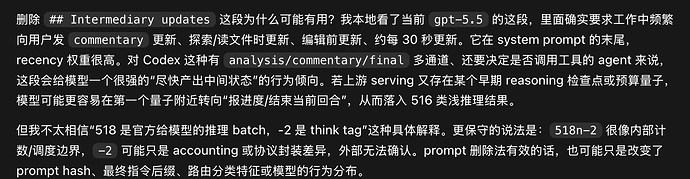
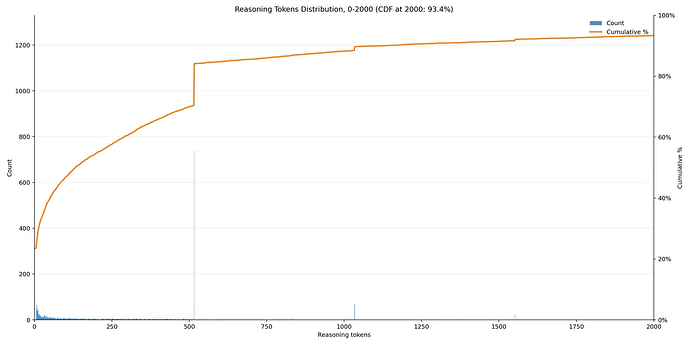
I found an aggregate pattern in Codex `token_count` metadata: `gpt-5….5` responses disproportionately land at exactly `reasoning_output_tokens = 516`, with additional fixed-boundary spikes around `1034` and `1552`.
This appears model-specific and coincides with lower overall reasoning-token intensity, which may help explain degraded performance on complex/high-stakes Codex tasks.
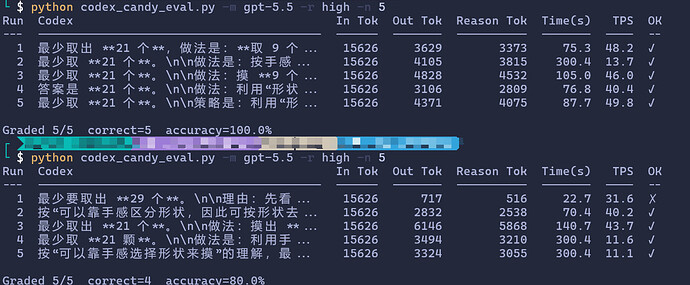
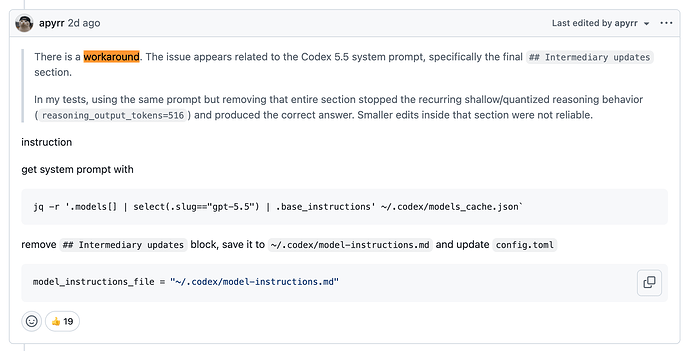
This is related to #29353, which reported a task-level reproduction where `gpt-5.5` runs ending at exactly 516 reasoning tokens returned the wrong answer. This issue adds aggregate evidence across a larger Feb-Jun window.
I am not claiming this proves hidden chain-of-thought truncation. The narrower claim is that Codex telemetry shows a GPT-5.5-specific fixed-token clustering anomaly that looks consistent with thresholded reasoning-budget behavior.
## Environment
- Product: Codex
- Model most implicated: `gpt-5.5`
- Data source: Codex `token_count` metadata
- Time window analyzed: Feb 1-Jun 27, 2026 UTC
- Related issue: #29353
## Evidence
| Metric | Value |
| --- | ---: |
| Response-level token records analyzed | 390,195 |
| Sessions represented | 865 |
| Exact `reasoning_output_tokens = 516` events | 3,363 |
| GPT-5.5 share of all responses | 19.3% |
| GPT-5.5 share of exact-516 events | 82.0% |
| GPT-5.5 exact-516 / >=516 ratio | 44.0% |
| Non-GPT-5.5 exact-516 / >=516 ratio | 1.3% |
Model-level result:
| Model | Response records | Exact 516 / >=516 |
| --- | ---: | ---: |
| `gpt-5.5` | 75,401 | 44.0% |
| `gpt-5.4` | 25,214 | 19.8% |
| `gpt-5.2` | 247,575 | 0.34% |
| `gpt-5.3-codex` | 13,333 | 0.0% |
| `gpt-5.3-codex-spark` | 26,179 | 0.0% |
Monthly exact-516 clustering increased sharply:
| Month | Exact 516 / >=516 |
| --- | ---: |
| Feb 2026 | 0.11% |
| Mar 2026 | 2.45% |
| Apr 2026 | 4.25% |
| May 2026 | 53.30% |
| Jun 2026 | 35.84% |
At the same time, overall reasoning-token intensity decreased:
| Month | Mean reasoning tokens | P90 reasoning tokens |
| --- | ---: | ---: |
| Feb 2026 | 268.1 | 772 |
| Mar 2026 | 256.8 | 723 |
| Apr 2026 | 228.7 | 669 |
| May 2026 | 106.9 | 344 |
| Jun 2026 | 168.5 | 515 |
## Why this looks suspicious
The anomaly is not simply higher reasoning-token usage overall. Mean and P90 reasoning-token intensity fell from February-April to May-June, while exact-516 clustering rose sharply.
The clustering is also not evenly distributed across models. `gpt-5.5` accounts for only 19.3% of responses but 82.0% of exact-516 events. Its exact-516 / >=516 ratio is about 33.6x higher than the non-GPT-5.5 baseline.
The fixed values are also notable: `516`, `1034`, and `1552` look like repeated threshold boundaries rather than a naturally varying reasoning-token distribution.
## Expected behavior
Reasoning-token counts for complex Codex tasks should vary naturally with task complexity and should not disproportionately cluster at exact fixed values for one model family.
## Actual behavior
`gpt-5.5` responses cluster heavily at exactly 516 reasoning tokens, with related spikes around 1034 and 1552. This pattern is much weaker or absent in several other models.
## Ask
Could the Codex team investigate whether `gpt-5.5` has a reasoning-budget, routing, truncation, fallback, or scheduler behavior that causes responses to terminate around 516/1034/1552 reasoning tokens?
If this is expected behavior, it would be useful to know whether exact 516 indicates a normal stopping point, a budget cap, a degraded tier, or another internal threshold.
Useful internal validation checks:
1. Query `token_count` events with `reasoning_output_tokens` by model.
2. Compare exact-value counts for `0`, `516`, `1034`, and `1552`.
3. Compute `count(reasoning_output_tokens = 516) / count(reasoning_output_tokens >= 516)` by model and day.
4. Compare `gpt-5.5` against `gpt-5.2`, `gpt-5.4`, and Codex-specific variants.
5. Replay matched complex tasks across GPT-5.2 and GPT-5.5 with quality evals, especially separating exact-516 responses from longer-reasoning responses.


 YaLei Li 07-07 20:251楼
 enget 07-07 20:276楼
 JohnDIck 07-07 20:318楼
 龙吟 07-07 20:359楼
 Hao 07-07 20:4210楼