原文:I Don’t Want to Read What You Didn’t Write
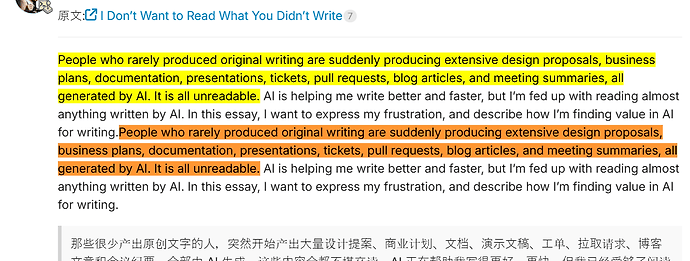
People who rarely produced original writing are suddenly producing extensive design proposals, business plans, documentation, presentations, tickets, pull requests, blog articles, and meeting summaries, all generated by AI. It is all unreadable. AI is helping me write better and faster, but I’m fed up with reading almost anything written by AI. In this essay, I want to express my frustration, and describe how I’m finding value in AI for writing.
那些很少产出原创文字的人,突然开始产出大量设计提案、商业计划、文档、演示文稿、工单、拉取请求、博客文章和会议纪要,全部由 AI 生成。这些内容全都不堪卒读。AI 正在帮助我写得更好、更快,但我已经受够了阅读几乎任何由 AI 写出的东西。在这篇文章中,我想表达我的沮丧,并描述我如何在写作中发现 AI 的价值。
AI Is Terrible for Writing
AI 的写作真的是一坨
A pattern I see is that people use AI to build something new, then they use AI to retrospectively summarize what they have already built into a design document. Reading a document like this isn’t just difficult—it is punishing. The design document is no longer a proposal to build consensus, bring people along with you, and refine ideas through slow, deliberate thinking—it is a summary made by a machine, in exhausting detail, without context or perspective. It is unreadable. Inhumane. The authors of these documents become impatient when people aren’t engaged, and it is hard not to be, because the thing they built is already working.[1]
我看到的一种模式是,人们用 AI 构建新东西,然后又用 AI 回顾性地把他们已经构建出的东西总结成一份设计文档。阅读这样的文档不只是困难——简直是一种折磨。设计文档不再是为了建立共识、带着人们一起前进、并通过缓慢而深思熟虑的思考来完善想法的提案——它变成了机器生成的摘要,细节详尽到令人精疲力竭,却没有背景或视角。它根本读不下去。不近人情。这些文档的作者在人们不投入时会变得不耐烦,而人们很难投入,因为他们构建的东西已经在运转了。 [1]
I also see more and more pull request summaries clearly written by machines for machines. They are rich in detail: this was changed to that, these things were split, those things were merged, this was left untouched, tests were added for this, and so on. But I’m left asking: Why are we doing this? What is the value? How risky or urgent is this work? Where do you want my input? What should I pay attention to? The same goes for tickets or meeting summaries made by AI. The writing, like more and more of the world, consists of statements outside of context.
我也越来越多地看到,pull request 摘要显然是由机器撰写、供机器阅读的。它们细节丰富:这个改成了那个,这些东西被拆分,那些东西被合并,这个原封未动,为此添加了测试,等等。但我却不禁想问:我们为什么要做这件事?价值在哪里?这项工作有多大风险或有多紧急?你希望我在哪里提供意见?我应该注意什么?由 AI 生成的工单或会议纪要也是如此。这种写作,就像世界上越来越多的事物一样,由脱离语境的陈述构成。
I had someone write me a personal message about a sensitive topic that was clearly workshopped with AI in an effort to nuance the conversation and not offend me. But the message became impersonal, dispassionate, and disjointed. It had all of the parts, but it didn’t make sense as a whole. I wasn’t interested in reading it, or responding. I would much rather someone be themselves and write with their own voice, or with some passion, even if they can’t quite find the words, or risk offending me.
有人就一个敏感话题给我写了一封私人消息,这显然是用 AI 反复打磨过的,想让对话更细致得体,不冒犯我。但这条消息变得没有人情味、不带感情,而且支离破碎。它各个部分都有,但作为一个整体却说不通。我没兴趣读它,也没兴趣回复。我宁愿人们做自己,用自己的声音,或者带着一些热情去写,哪怕他们一时找不到恰当的词,哪怕有可能冒犯我。
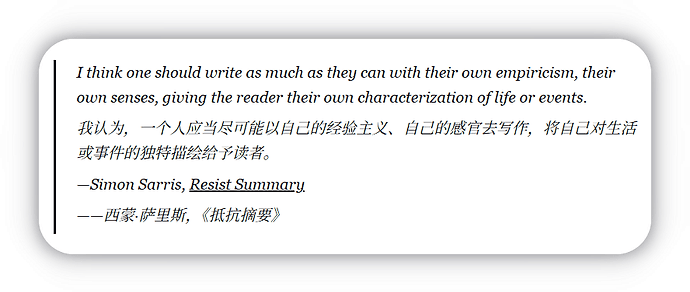
In relationships with others, there is vulnerability and risk. In communicating with your AI, there is none, and attempts to eliminate vulnerability and risk will eliminate the process of relationship itself. As Simon Sarris writes in Resist Summary, an essay I keep returning to:
在与他人相处的关系中,存在着脆弱与风险。而在与你的 AI 交流时,这些都不存在,而试图消除脆弱与风险的尝试,也将消除关系本身的过程。正如西蒙·萨里斯在《抵抗摘要》中所写,这篇文章我反复品读:
Perhaps the laziest and most offensive use of AI writing I have seen: I had someone use AI to summarize my comments on their proposal as their response to me! Thanks! I couldn’t have said it better myself![2]
或许我所见过的最懒惰、最令人反感的 AI 写作应用:有人竟用 AI 来总结我对他们提案的评论,作为对我的回应!真是谢谢了!我自己都没法说得比这更好! [2]
I Don’t Have the Context You Do
我没有你所谓的“上下文”
Cynthia Dunlop recently shared survey results on reading AI-written articles entitled Report: How developers react to AI-scented blog posts. For the majority of readers, if they think an article is AI-assisted or AI-authored, they will stop reading (78%) and avoid the author in the future (71%). As Bryan Cantrill wrote about this research in his essay The revolt of the reader: “our brains pull an LLM-triggered ejection handle, bailing us out mid-sentence in an act of self-preservation.”
Cynthia Dunlop 最近分享了一项关于阅读 AI 撰写文章的调查结果,题为《报告:开发者如何回应带有 AI 气味的博客文章》。对大多数读者来说,如果他们觉得一篇文章是由 AI 辅助或由 AI 撰写的,他们就会停止阅读(78%),并在未来避开该作者(71%)。正如 Bryan Cantrill 在其文章《读者的反抗》中谈到这项研究时所写:“我们的大脑会拉下由 LLM 触发的弹射手柄,在句子中途将我们弹出,作为一种自我保护行为。”
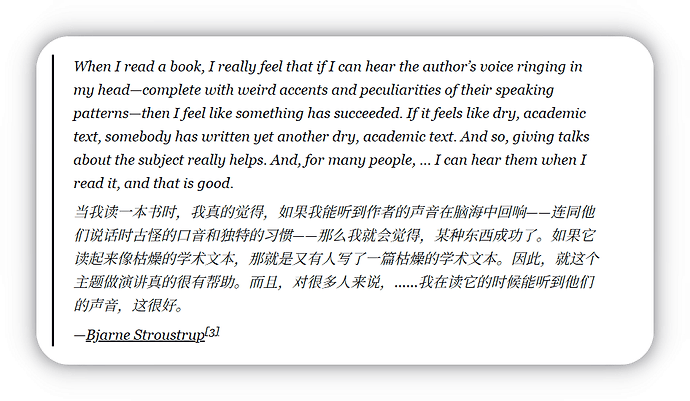
The strongest result in the survey was people overwhelmingly preferred the author’s own writing (98%), with all its flaws and idiosyncrasies, as compared to a soulless rewrite by an AI. Writing authentically is one of the best ways to connect with people. It reminds me of a comment Bjarne Stroustrup, the creator of C++, made during a panel discussion I attended over a decade ago on writing books:
这项调查中最显著的结果是,相较于 AI 毫无灵魂的改写,人们以压倒性多数更喜欢作者自己的写作(98%),连同它所有的瑕疵和独特之处。真诚地写作是与他人建立联系的最佳方式之一。这让我想起 C++ 的创造者 Bjarne Stroustrup 十多年前在我参加的一场关于写书的专题讨论中所说的一句话:
When you are the one who prompted the AI, the written output is often quite useful. But do not mistake this for effective writing. When you read the output, you already have lots of context—you formulated the prompts, established the constraints, and provided artefacts like documentation, source code, logs, statistics, pictures, etc., that led to the output. You can skim the output and quickly decide what is relevant and valuable versus what is irrelevant or wrong. You are also part of the process—prompting the AI and seeing the results—a call and an answer. You bring a human perspective to the machine. When you send the same text to someone else, they have little to no context. They are not part of the process—there is no unfolding—so it is much harder to decide what is relevant versus what is not. They are forced to read exhaustively and consider every line, peering into the internals of a machine with the hope of establishing context. It is only natural to stop reading.
当你自己是为 AI 提供提示的人时,生成的文字输出往往相当有用。但不要把这误认为有效的写作。当你阅读输出时,你已经有大量上下文——你构思了提示词,设定了约束条件,并提供了文档、源代码、日志、统计数据、图片等促成输出的材料。你可以略读输出,快速判断哪些内容相关且有价值,哪些无关或错误。你也是这个过程的一部分——向 AI 提示并查看结果——一问一答。你为机器带来了人类的视角。当你把同样的文本发给别人时,他们几乎没有或完全没有上下文。他们不是这个过程的一部分——没有逐步展开的过程——因此更难判断哪些内容相关、哪些不相关。他们被迫逐字逐句地通读,考虑每一行,窥视机器内部,希望借此建立上下文。停止阅读再自然不过了。
AI Can Be Great for Writing
AI 可以极大地助力写作
I recently wrote an academic paper.[4] I used AI extensively and it made the writing process faster and more enjoyable. But AI did not write a single line of the paper. I wrote the paper in LaTeX. The context I provided to the AI included the journal style guide and LaTeX template, all papers previously published in the journal, the source code for the software systems I was writing about, and the configuration, logs, and metrics for production deployments of the software.
我最近写了一篇学术论文。 [4] 我大量使用了 AI,它让写作过程更快、更愉快。但 AI 并没有写论文中的任何一行。我用 LaTeX 写论文。我提供给 AI 的上下文包括期刊风格指南和 LaTeX 模板、该期刊此前发表过的所有论文、我所撰写的软件系统的源代码,以及该软件生产部署的配置、日志和指标。
After writing a paragraph, many times I would ask the AI to ensure what I had written was correct by referencing the source code or configuration, or examining production logs or metrics. For example, ensuring I had correctly described which columns in the database were indexed, or how the rows in the Parquet files were sorted. This allowed me to stay in the context of writing, often moving on to the next paragraph while the AI verified the previous one. It helped me spot important omissions and inaccuracies. Remarkably, reversing this process—asking the AI to write the paragraph from the context I provided, like describing how something works from the source code—was never valuable. Not once. It was consistently unpleasant to read, and often inaccurate.
写完一段之后,我常常会请 AI 通过参考源代码或配置,或检查生产日志或指标,来确保我写的内容是正确的。例如,确保我正确描述了数据库中哪些列被索引,或者 Parquet 文件中的行是如何排序的。这让我能够保持在写作的上下文中,常常在 AI 验证前一段时继续写下一段。它帮助我发现重要的遗漏和不准确之处。值得注意的是,反过来做——让 AI 根据我提供的上下文来写段落,比如根据源代码描述某个东西如何工作——从来都没有价值。一次都没有。它读起来总是令人不快,而且常常不准确。
Another thing that helped me stay in context was using AI to complete the citations. It is tedious to look up the details of a paper, website, or book, fill in the BibTeX format, and then reference it in the text. Instead, I would leave parenthetic instructions for the AI to reference what I wanted, and then keep on writing without breaking stride.[5]
另一件帮助我保持上下文的事情是使用 AI 来完成引用。查找论文、网站或书籍的详细信息,填写 BibTeX 格式,然后在文本中引用它,这很乏味。相反,我会留下括号内的说明,让 AI 去引用我想要的内容,然后继续写作而不打断节奏。 [5]
The AI was incredibly good—indeed ruthless—at finding spelling and grammar mistakes. It was great at suggesting simplifications to sentences that are too long or unclear.[6] It was skilled at drawing technical diagrams in TikZ, again speeding up the work, and saving me from learning this syntax. The AI even found a very subtle mistake where I had used the incorrect notation in one paragraph, something four human reviewers who were experts in the system all missed.[7]
这个 AI 在查找拼写和语法错误方面极其出色——甚至可谓毫不留情。它非常擅长为过长或含义不清的句子提出简化建议。 [6] 它还擅长用 TikZ 绘制技术图表,这再次加快了工作,也让我不必去学习这种语法。AI 甚至发现了一个非常细微的错误:我在某一段中使用了错误的记号,而四位精通该系统的人类审阅者都漏掉了它。 [7]
…更多内容见原文


 yi124773651 09-22 14:291楼
 冯诺1曼 09-22 14:463楼
 painpwater 09-22 14:514楼
 nyavana 09-22 14:565楼
 cy fan 09-22 15:327楼
 Infinity Shen 09-22 20:469楼
 Smoaflie 09-22 21:3410楼