OpenAI 高管批 Kimi K3 开源,硅谷多方驳斥其观点

拾雨 2026-07-20 23:23 1

IT之家 7 月 20 日消息,据 Business Insider 报道,每隔一段时间,就会有一家中国企业发布新的 AI 模型,然后引发美国人的恐慌。


上周,中国 AI 公司月之暗面(Moonshot AI)发布 Kimi K3 模型后,这种情况再次出现。该模型在多项重要基准测试中取得亮眼成绩。从各方面来看,Kimi K3 的能力已经接近部分领先的美国 AI 模型,但成本却低得多。


这一新模型再次引发了美国对于中国正在缩小与美国 AI 差距的担忧。一些人甚至指责中国企业是在利用 Anthropic、OpenAI 和 Google 已完成的研究成果训练自己的模型。


如今,中美 AI 竞争的核心矛盾越来越集中在两种截然不同的发展路线:中国企业正在积极拥抱开源或开放权重模型,而美国企业大多仍坚持封闭模式。


所谓开放权重模型,是指开发者可以查看模型参数,并根据自身需求进行修改、定制和部署。


开源还是闭源,AI 行业爆发激烈争论


上周末,在 OpenAI 一名高管针对 Kimi K3 发布长篇评论后,X 平台上围绕 AI 开源与闭源模式展开了激烈讨论。


IT之家注意到,OpenAI 新任战略负责人 Dean Ball 曾担任美国总统唐纳德 · 特朗普的 AI 高级顾问。他在 X 上写道:“考虑到潜在风险,我个人很惊讶中国政府仍然允许如此强大的模型进行开源。”


他认为,开源模型可能具有“减速主义”倾向,因为它们会“抑制 AI 资本支出”。


不过,真正引发大量讨论的是他的另一番言论。


Ball 写道:“我猜测,特朗普政府最终会意识到,在这一领域最好的策略,是围绕中国开放权重模型的使用制造大量监管风险。”


他的观点是,通过监管流程制造恐惧、不确定性和怀疑,也就是业内常说的“FUD”,可能会让大多数美国企业避免采用开放模型。


随后,Ball 解释称,这只是他的预测,并非政策建议。他表示,自己支持开源模式,直到 AI 发展到过于危险的阶段,而那将是一个“令人悲伤的日子”。


他的言论迅速引发广泛回应。


一些批评者认为,通过制造监管混乱来保护美国 AI 实验室,很像“监管俘获”(regulatory capture)—— 即负责监管某个行业的政府机构,最终制定出有利于该行业企业发展的规则,而这些规则往往受到行业内部人士的影响。


OpenAI 和 Anthropic 坚持闭源路线


Anthropic 和 OpenAI 一直认为,它们的模型能力过于强大,不适合开放。两家公司认为,如果完全开放模型,任何人都可能利用这些工具实现各种目的,而缺少有效监管。相比之下,封闭系统能够让开发者对模型拥有更强控制力,包括安全机制、访问权限以及商业定价。


这两家 AI 公司也曾警告,中国推出的开放权重模型可能对国家安全以及自身商业利益构成威胁。


风险投资人 David Sacks 曾担任特朗普政府首任 AI 和加密货币负责人,并于今年 3 月转任总统科技顾问委员会联合主席。他批评“利用监管不确定性作为武器”的做法,称其“完全不可接受”。


Sacks 在回应 Ball 的帖子时写道:“我们正处于 AI 政策的关键转折点。领先的闭源实验室已经在 AI 模型收入方面形成双头垄断,现在它们希望政府消灭自己的开源竞争对手。”


他所说的“双头垄断”,指的是 OpenAI 和 Anthropic。


Sacks 表示:“它们已经亮出了自己的底牌。现在,是时候让硅谷其他力量 —— 绝大多数仍然重视开放竞争的人 —— 也表达自己的立场。”


支持开源者:开放才是 AI 的未来


Sacks 的“All-In”播客联合主持人、风险投资人 Chamath Palihapitiya 也表达了类似观点。他在 X 上写道:“未来属于开源。我们需要拥抱它,然后继续前进。”


知名软件工程师、企业家 Suhail Doshi 则表示,美国 AI 实验室训练自己的产品时,使用的是“全人类的数据,却没有支付一分钱”。他写道:“任何以‘模型蒸馏’为理由,试图推动禁止开放权重模型的游说或立法,都是完全胡扯。这实际上是在阻碍未来美国创新。”


不过,并非所有人都认同这一观点。


Citrini Research 分析师、X 平台用户 Jukan 反驳了 Ball 关于“中国 AI 将占据主导地位”的担忧。他认为,开源模型并不会自动让企业获得市场优势。


Jukan 以中国 AI 公司 DeepSeek 为例表示,该公司的竞争力来自自身运营效率,而不仅仅是开源框架。


他说,DeepSeek 之所以能够保持较低的 Token 成本,是因为其内部运营方式更高效,而不是单纯依靠开源。


Jukan 写道:“中国企业可能缺乏足够的计算能力,无法独自满足所有推理需求,但它们并不是在亏本销售,也不是无法收回训练成本。”


此前消息:OpenAI 战略未来主管批 Kimi K3 开源:非常优秀的模型,但本质上是减速主义,阻碍进一步的 AI 资本支出

最新回复 (13)
  • 量子咸鱼K 07-20 23:37
    1

    开源模型可能具有“减速主义”倾向,因为它们会“抑制 AI 资本支出”。


    是围绕中国开放权重模型的使用制造大量监管风险。


    叽里咕噜说什么呢? 中国肯定不希望搞一大堆AI相关的金融泡沫啊,最好是相关需求能给国产算力搞落地了,这样就不用给英伟达送钱了。


    至于什么监管风险,这怎么炒作呢?难道还能有比企业内部离线自部署更安全的策略?把数据交给G,O,A难道比放自己手里还安全?

  • Demorain 07-20 23:42
    2

    这个怎么在讲中国开源有风险,奥特曼啥的闭源就没事了?又想搞TikTok那一套吗

  • CNJK49 07-20 23:43
    3

    美国 AI 实验室训练自己的产品时,使用的是“全人类的数据,却没有支付一分钱”。

    太对了,用了我的数据训练,还不让我用…臭不要脸

  • ddddx 07-20 23:44
    4

    哪来的路边一条,天天诋毁我国科技发展

  • hwang 07-20 23:45
    5

    闭关锁国要不得,还是得打开大门做生意

  • CNJK49 07-20 23:46
    6

    别封闭了,大美利坚还敢闭关锁国?

    开门,做生意 ^-^

  • 295329161 07-20 23:59
    7

    我猜kimi是这么想的:没有那么多算力卡,吃不下那么大的市场,那就开出来谁有能力谁吃!也欢迎a/部署kimi ^-^

  • lueluelue 07-21 00:01
    8

    原文:

    转载

    https://x.com/deanwball/status/2078133895766114412


    仅代表他的个人观点


    Some observations on Kimi:


    1. It’s a very good model! I don’t think its performance can be explained away by distillation or anything like that. In agentic coding sessions, it seems pretty much on par with the best public models of Q1 2026. In my fairly limited use, it also seemed very token hungry. It’s not obvious to me that this model is actually that cheap to run.


    2. I am personally surprised the Chinese state continues to allow the open sourcing of models this good, given potential risks. To be clear, I *myself* might be fine with models presenting this level of marginal risk being open weight, but I am surprised that China is fine with it. I suspect the reason they are is 75% explained by strategic blindness/lack of AGI-pilledness (the CCP is very Yann Lecun-y in its views of AI). The other 25% or so is their lack of compute for customer inference (making China’s open-weight strategy an unintended byproduct of US export controls) and the normal Chinese strategy of aggressive exports. For the companies, as opposed to the government, the decision to open source is partially ideological and partially because they are behind, and they know that very few people would pay for sub-frontier models from China.


    3. Open-weight models are inherently decelerationist, and I’m continually surprised to see the so-called “accelerationists” so excited about open-weight models. I suspect the reason they are is that they know open-weight models are effectively ungovernable, and they simply like the overall cloak of ungovernability open-weight models create over the whole of AI. It’s not a bad strategy; it reminds me of James Scott’s recounting of the hill people in “the art of not being governed.” Still, in the end, open-weight models deter further AI capex.


    4. One probable outcome of an open-weight-model-dominant world is full AI communism, which is precisely what China proposes: rather than a market product, AI is a “public good” which will ultimately be provided by the state as a kind of “digital public infrastructure.” This future strikes me as a dystopian hellscape, but I’ve never met an open-weight models advocate who doesn’t ultimately concede this is where things end. You’d be surprised how many ‘accelerationists’ lobbied me, while I was in government, to support an eleven or twelve-figure federally funded data center so that startups could train models at a subsidy and then give them away for free. There was no other way for AI to progress, they said. Perhaps this is the logical end state of things. Nonetheless, I find myself surprised to see supposed accelerationists excited about such an outcome. I think many of them just don’t know what they’re doing. Many accelerationists do not view the creation and serving of frontier models as a legitimate business.


    5. I would guess that the Trump Administration will at some point realize that their best strategy here would be to create large amounts of regulatory risk around the use of open-weight Chinese models. You don’t need to “ban open source” (one of the dumber motifs of AI policy discussion). You just need to direct every agency to issue soft law that creates FUD. “A Federal Reserve Advisory Bulletin found that there may be backdoors in Chinese AI models.” It needn’t be that well justified. You just create enough regulatory risk that every regulated enterprise backs off. You probably don’t want to create so much regulatory risk that you scare off the hyperscalers from serving Chinese models; this will just drive startups to sketchier providers. There’s a happy middle ground here. I’d assume they will do some version of this.


    6. It’s probably true that open-weight models of this capability make the world a bit more dangerous, but not so much more that you’ll really notice. At some point the models will be capable enough that you will notice. “A nonliving, invisible, dangerous, and infinitely self-replicating agent escaped from a Chinese lab,” you say? Color me shocked.


  • 阿森 07-21 08:28
    9

    这么大参数的模型开不开源对于普通人来说都是闭源 ^-^

  • stk 07-21 08:49
    10

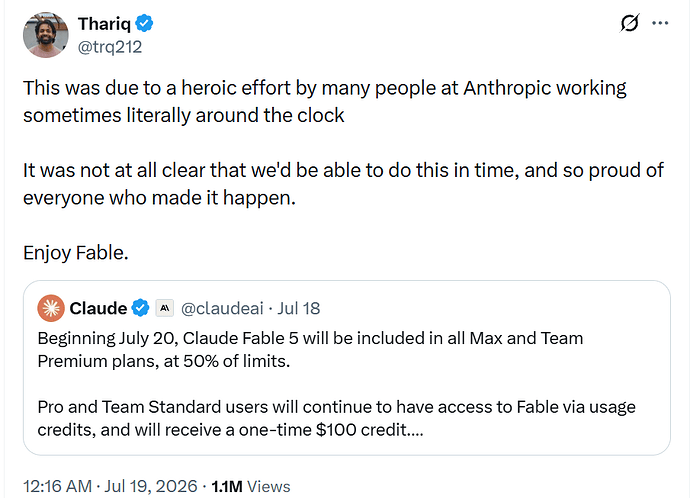
    闹得麻麻的。谁还记得之前A/天天扯自己的mythos模型多么危险,后面被搞的fable上线又立马下架了,然后sol一出来又不停延期,到现在kimi出来没几天,又发文enjoy fable了 ^-^ ,合着fable一会too dangerous for common ppl to use,一会又大家请尽情享用fable了是吧 ^-^


  • Breeze 07-21 09:20
    11

    你猜会不会是领导要求呢?看看最近新闻讲话

  • bnking1988 07-21 09:26
    12

    哈哈哈,典型的白皮强盗思维,跟自由贸易一个德性,我强的时候就自由贸易,我不占优势了就封锁限制围追堵截你

  • 轻度宅 07-21 10:23
    13

    对于企业来说,数据安全才是优先级更高的吧,把数据交给A和O,用不了多久,他们就能直接出个竞品产品吊打你 ^-^

* 帖子来源Linux.do
返回